
It usually starts with a sound. A flat, loud bang from the garage, like a dropped wrench or a small firecracker, and then nothing. You press the button and the opener hums while the door barely moves, or the door lifts a foot and quits, or it will not budge at all. If you are searching for garage door spring repair in Phoenix, that bang is very likely what happened: a torsion or extension spring reached the end of its life while the door sat still.
This page explains what just failed, what helps and what hurts in the first few minutes, how the two spring types differ, why Valley heat and cycle counts matter, and what a proper replacement involves. If a car is trapped or the garage is open to the street, read the emergency repair page, then call (480) 790-6364 to schedule the soonest available visit.
What a broken spring sounds and looks like
A spring does its work quietly for years. It is a coil of hardened steel that stores energy when the door comes down and gives it back when the door goes up, which is why a heavy panel door feels almost weightless in your hand. When a spring lets go, all of that stored energy is released in a fraction of a second. People describe the sound as a gunshot or a crack. Others never hear it, because they were in another room or at work, and they find out that evening when the remote does nothing useful.
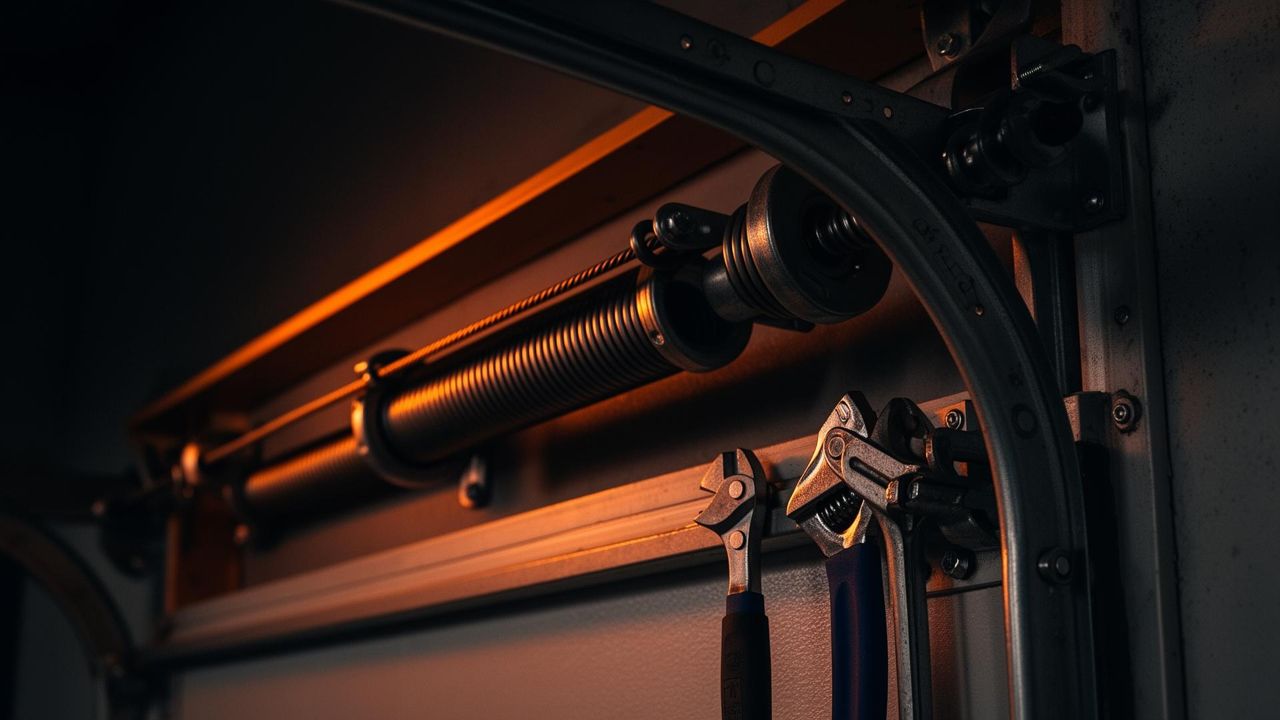
What you see afterward depends on the system. On a door with one or two torsion springs on a bar above the opening, a break leaves the door as dead weight. A typical two-car door weighs well over a hundred pounds, and the opener was built to guide a balanced door, not to lift one that has lost its counterweight. So the motor hums, the carriage may jerk, and the door rises a few inches at most. Look above the door and you may see a gap of an inch or two in one of the coils.
On a door with extension springs along the side tracks, a break more often shows up as one side hanging lower than the other, because each side has its own spring. You may find a stretched or snapped spring lying on the garage floor.
Not every stuck door is a spring. A dead opener with no light, a door that starts down and reverses and a door that rises crooked point elsewhere; see opener repair and cable repair. A closed door that feels like a loaded hood with no strut points to a spring, but that lift test belongs to a technician.
Why you never do this yourself
Spring energy does not vanish because a spring is broken. On a two-spring door the survivor still carries load, the brackets at the bottom corners are still under tension, and a door stopped partway up can fall if anything disturbs it. DASMA, the garage door industry association, calls springs arguably the most important and most dangerous part of a door and says spring systems should be repaired only by trained professionals. Winding bars slip. A slipped bar can break fingers, wrists or a jaw, and it happens to experienced people.
Only a technician should touch the set screws or winding bolts, and a spring should never be ordered online and matched by eye. The first few minutes go better with a short list.
- Keep people, pets and vehicles away from the door, especially if it stopped partway up.
- Leave the springs, the cables and the bottom corner brackets alone. They carry load even when nothing is moving.
- If nothing urgent depends on the door, wait for a technician. A closed door with a broken spring generally stays put.
- Do not keep pressing the remote. A motor fighting a dead-weight door strips its drive gear and can bend the top section.
- Do not pull the red release cord when the door is open or partway up. Once the opener lets go, a door with a broken spring can come down fast.
Torsion springs and extension springs
Nearly every residential door in the Valley uses one of two systems. Which one you have changes both the failure and the repair.
A torsion system mounts one or two springs on a steel shaft above the door. Cables wound on drums at the ends of the shaft turn it as the door travels. Lowering the door twists the springs tighter, and raising it lets them unwind and lift. Each spring is sized to its door, and wire thickness, coil length, inside diameter and winding direction all matter, because the springs have to hold that exact weight in balance. Torsion is standard on newer houses and on most doors installed in the last few decades.
An extension system runs a long spring along each horizontal track, anchored near the ceiling at the back, with a pulley and cable at the front. The spring stretches as the door lowers and pulls the door up as it contracts. These are common on doors from the 1950s through the 1980s and still turn up on lighter doors in older ranch neighborhoods. Each extension spring should carry a safety cable through its center, anchored at both ends, so a broken spring is contained instead of whipping across the garage. DASMA advises a safety inspection for any extension-spring door that lacks one.
Cycle math, and what Phoenix heat adds
The standard torsion spring carries a rating of about 10,000 cycles, where one cycle means one lift and one close. The rating is a count, not a calendar. Leaving once and coming home once is two cycles, because the door opens and closes each time.
- At 2 cycles a day, a 10,000-cycle spring lasts roughly 14 years.
- At 4 cycles a day, roughly 7 years.
- At 8 to 10 cycles a day, which a household with school runs, deliveries and two commuters can reach, roughly 3 years.
In a Valley subdivision where the garage is the front door, that arithmetic explains why a house in its first decade can already be on a second set of springs.
Heat does not snap a spring by itself. Springs fail from fatigue: every cycle flexes the steel, and eventually a crack lets go. Heat raises the cost of each cycle. An attached garage with no cooling can run 20 to 30 degrees hotter than the air outside, and many garages sit beneath an attic that gets far hotter than that by midday. Lubricant thins until it runs off the coils, and old grease bakes into a sticky film. Add the fine dust that monsoon wind pushes through every gap, and the coils rub against each other and the shaft with less protection each season. West-facing doors have it worst, because afternoon sun hits the panels directly and the garage behind them stays hot long after sunset. The Phoenix heat and garage door springs guide goes deeper on this.
High-cycle springs
Builders commonly choose the least expensive spring that meets the standard 10,000-cycle rating. A replacement is the moment to choose differently. High-cycle torsion springs use thicker wire and more length, and ratings of 25,000 cycles and higher are sold alongside the standard. For a household at eight cycles a day, that is the difference between replacing springs about every three years and replacing them every eight or more.
What spring replacement costs in the Phoenix area
No honest number exists for a door nobody has seen, but a typical range helps you judge a quote. In metro Phoenix, many homeowners pay roughly $200 to $500 for a standard torsion spring replacement, and more when a high-cycle set, a second spring, a bent shaft or new cables are involved. Treat that as a market range, not a quote. What moves a price:
- Door size and weight. A wide, insulated or windowed door needs stronger or longer springs than a light single-layer one.
- One spring or two, torsion or extension, because parts and labor differ.
- The cycle rating you choose. A high-cycle set costs more up front and lasts longer.
- The condition of the cables, drums, bearings and shaft around the spring.
- The hour of the visit, since a midnight emergency is a different job from a scheduled one.
You hear the price before any work starts, and you decide whether to go ahead. The garage door repair cost guide lays out typical ranges for the other common repairs.
Pairs, and replace or repair
On a two-spring door the technician will normally recommend replacing both even if only one broke, and DASMA gives the same advice. The survivor has the same age and cycles, and a new spring paired with a tired one can leave the door lopsided. A replacement visit also checks cables, drums, bearings, rollers and tracks, rebalances the door, and retests the opener reversal.
Replace the spring, or replace the door
A spring is among the most worthwhile repairs a door can have, because the rest of the door is usually fine. It stops making sense when the spring is one of several failures. Cracked or rusted sections, tracks that will not hold their shape, a failing opener and a broken spring together say that each repair buys less time than the last. Ask for both prices on the same visit. Installation covers what a new door involves.