
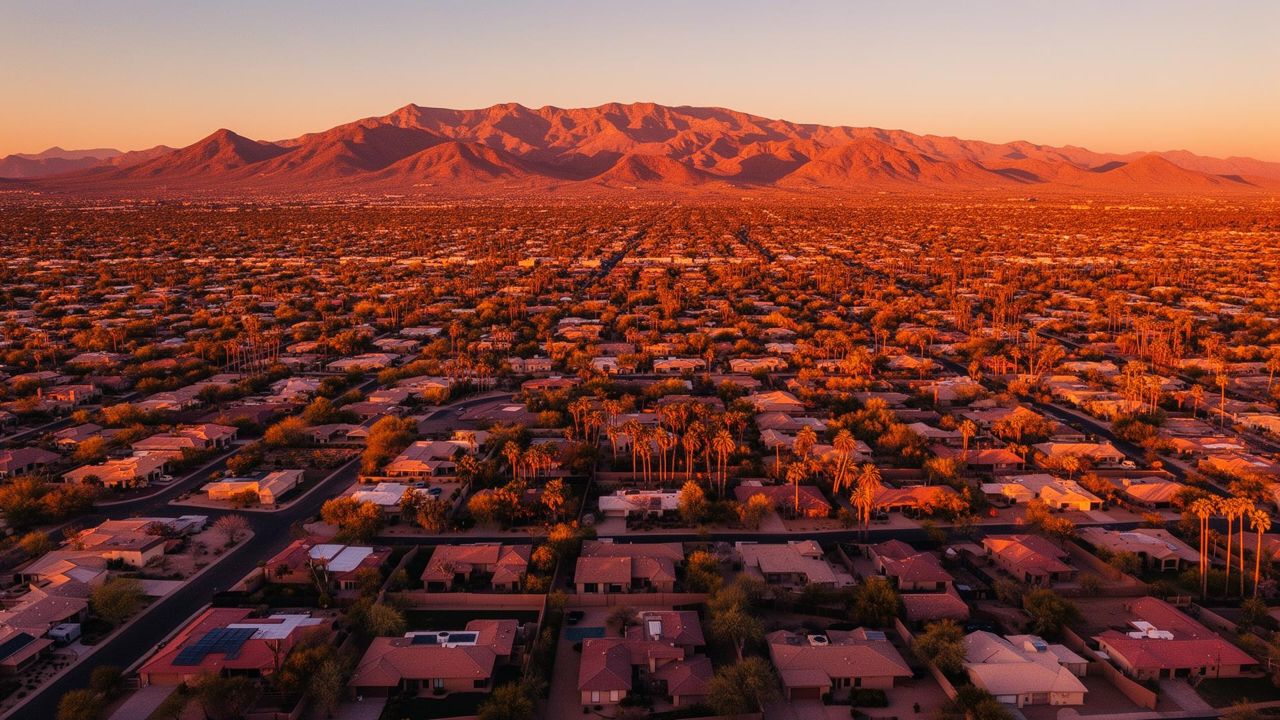
It is late afternoon in July, the dashboard says 111, and you pull in with a trunk full of groceries. You press the remote. The door lifts a few inches, shudders and drops. Or you were inside when something went off in the garage like a dropped wrench, and now the door will not move.
This page explains garage door repair in Glendale from the failure backward: what the noise probably was, how the age of your part of town changes the answer, and what to do in the next ten minutes. If you need help now, call (480) 790-6364.
Reading the symptom
A bang followed by a door that will not lift is, far more often than not, a broken torsion spring. That is the coil of steel above the door that does the real lifting. Without it a two-car door is a dead weight of well over a hundred pounds, and the opener, which was only ever meant to guide the door, either strains or refuses to try. See spring repair for how the fix works.
A few other signs sort out the rest. A door that rises crooked, or hangs lower on one side, points to a frayed or snapped lift cable, which is a job for cable repair. A door jammed in the curve of the track has come off its rollers, often after a bumper tap or a gust, and forcing it can crease the sections. If the opener hums or clicks and the door stays put, suspect a broken spring or a disconnected carriage. If the opener is silent and its light is off, check the breaker and the remote battery first. If the door starts down and reverses, the photo-eye sensors near the floor are dirty or out of line.
While you wait, keep kids, pets and cars away from the door. Stay clear of the springs, cables and bottom-corner brackets, which carry load even at rest. If the door is closed and a car is trapped inside, the red release cord disconnects the opener so two people can lift the door by hand, slowly. If the door is open and you suspect a spring, leave it where it is. For anything that cannot wait overnight, emergency repair is the page to read.
Why the afternoon matters
Springs do not break because it is afternoon. Afternoon is when people come home, use the door most and notice. A garage that is not cooled stays hot long after sunset, and steel grows in that heat and shrinks overnight. A spring already near the end of its typical 10,000-cycle rating tends to finish the job on one of those swings. A west-facing door takes the afternoon sun head on, which bakes its seals and weatherstripping faster than a shaded north-facing door.
Historic Downtown and the older grid
Glendale started as a temperance colony in 1892 and incorporated in 1910, and its downtown grew while Phoenix was still miles off across open ground. Catlin Court, platted in 1914 and listed on the National Register of Historic Places, holds early 1920s bungalows next to the antique shops of Historic Downtown. Around it, older residential districts show when each stretch was laid out: Floralcroft in the late 1920s, Glendale Tract in the 1930s, Sands Estates through the 1950s and 1960s.
In the oldest blocks the garage was often added later or sits behind the house, and door sizes can be nonstandard. Headroom for an opener may be tight. Repairing what is there is often smarter than forcing a modern door into an old opening. If your house is a designated historic property, find out what review applies before changing how the door looks.
Central Glendale: the 1950s through the 1980s
Between downtown and the northern master plans, central Glendale reflects the decades when the city grew fastest. Glendale Community College opened in 1965, and the population climbed from about 16,000 in 1960 to nearly 100,000 by 1980. Houses from that stretch are now forty to sixty-five years old. Their original doors are mostly gone, but their openers, tracks and springs were often replaced one at a time, so a single garage can hold parts from four different decades.
The typical complaint here is a door that is almost fine. It travels slowly, rattles on the way up, sags in the middle or needs two presses of the remote. Those are signs of an unbalanced door and tired hardware, and they cost less to fix before a spring settles the matter for you. A tune-up is the visit built for that stage.
Arrowhead Ranch and the north end
Arrowhead Ranch is what most people picture when they think of north Glendale. It was built in phases from the late 1980s, reaches from Deer Valley Road south toward Union Hills Road, and runs west from 51st Avenue to the Loop 101. Its phases include Arrowhead Lakes and the Highlands at Arrowhead Ranch, with golf courses and the large Thunderbird Conservation Park along the northern edge.
Homes there date from the late 1980s through the 2000s, so doors range from about fifteen to nearly forty years old. In the earliest phases, any springs that are still original are far past their rated life. Master-planned communities generally have design rules, so check what your association requires before ordering new panels, a different color or a window pattern. New springs, cables or an opener leave the door looking the same and rarely raise the question.
Westgate and the west edge
West of the Loop 101 the city is a different place. Westgate, the entertainment district beside State Farm Stadium, is mostly apartments, condos and commercial space, so few doors there belong to individual homeowners. Farther out, the Loop 303 pulled in industrial development, farm fields still line stretches of the 101, and the New River and Agua Fria River run down the western side.
Homes near open fields and washes see more fine dust settling into track channels and onto sensor lenses. A few minutes with a soft cloth and a dry brush several times a year keeps a door from refusing to close because a lens looks blocked.
What to have ready when you call from Glendale
Glendale covers about 65 square miles, so the cross streets matter. Have the door width ready (a two-car door is commonly sixteen feet, a single eight or nine), the number of springs you can see, whether the door is open or closed, and a phone photo of the label on the door's edge or the opener. Ask for the whole door to be checked, not only the broken part. A failed spring often comes with worn cables or rollers, and replacing those in one visit beats a second trip.
The neighbors have their own housing stories. See Phoenix, Peoria and Avondale, or the service areas page for the full list.