
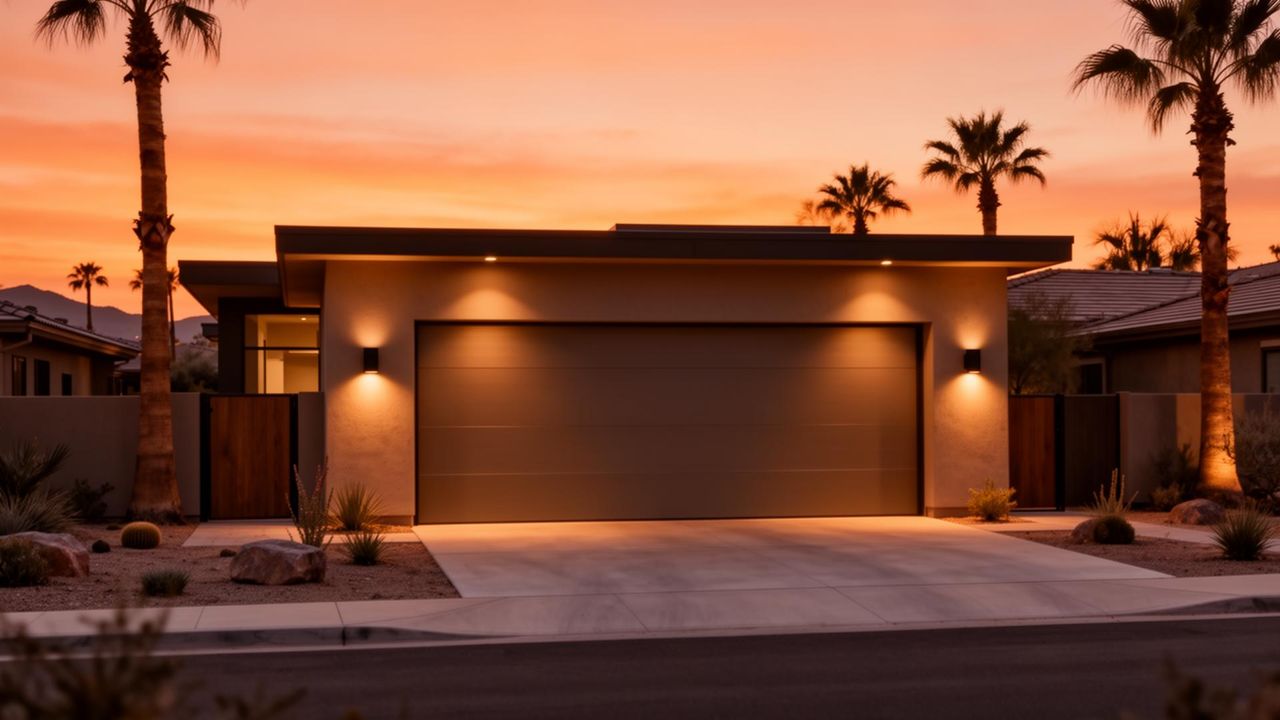
A dented section is easy to spot and easy to fix. The hard part of garage door panel replacement in Phoenix is everything around the dent: finding a section that is still made, getting it to sit beside panels that have spent years in Valley sun, and, in many neighborhoods, getting an architectural committee to say yes before anything is ordered. This page starts with the matching and approval problem, then walks through how a section is swapped, what makes the repair last through a Phoenix summer, and when swapping one section stops being the smart move.
If a panel is cracked, pushed in or hanging loose and the door will not close, call (480) 790-6364 to schedule a visit, and read the emergency repair page for how to make the garage safe while you wait. A door that cannot close gets secured first. The matching question can be settled after that.
Matching comes first: discontinued designs, faded color and panel profiles
A garage door section is not a generic part. It has a height and a thickness, a panel or rib pattern, a surface texture and a color, and often a set of windows or decorative hardware, and every one of those has to agree with the sections beside it. Manufacturers retire designs and revise colors, so an older door can be hard to patch when its type, style or color has been discontinued.
The practical test is whether the door's maker still builds that profile in that height. The label on the bottom section or on a panel edge usually shows the model and a date, and a phone photo of it saves a lot of guessing. Add the width of the door, the section height, whether the door is insulated and where any windows sit. With those facts a supplier can answer yes, no or close.
Color is the second half of the problem, and in the Valley it is the harder half. Ultraviolet light breaks down the paint on steel doors until it fades and chalks, and sun damage can show within a year or two depending on exposure. Phoenix afternoons in July average around 106 degrees, and a west-facing door takes that heat and light head on. A new section in the original factory color, set next to sections that have baked for a decade, can look like a clean stripe across the door.
Three outcomes when an exact match does not exist
- A close match: the same profile in the nearest current color. It works best on a door with modest fade, or on a door that sits in shade for much of the day.
- A blended finish: the new section is painted or refinished to sit closer to its neighbors. Ask before anyone paints a factory-finished panel, because a maker may treat a repaint as something that affects the coverage on that section.
- Every section together: replace all of them so they age at the same rate from day one. It costs more up front, it ends the matching problem, and an architectural committee will usually find it the easiest to approve.
Age shifts the odds. Replacing a section is more straightforward on a door bought in the last 10 to 15 years, and it gets harder after that as parts and colors turn over. A technician who sees the door in person can tell you which of the three outcomes is realistic before anything is ordered, which is cheaper than finding out from a mismatched delivery.
HOA and architectural approval: what needs a request
Many Arizona communities require approval before the outside of a home changes. Published guidance from Arizona community managers lists garage doors alongside exterior paint, stucco and entry doors among the items that need an architectural request, and committees typically weigh design, color and materials. Replacing a crushed section with an identical one restores what the street already saw, which is a different question from changing the design. Whether your association treats it as maintenance or wants a request on file is a matter for your own governing documents.
The Valley's housing eras make the difference practical. In master-planned communities built from the 1990s through the 2010s, color palettes are tight, and a mismatched panel can draw a letter by itself. In 1950s through 1970s ranch neighborhoods, many of them without an association, the rules are looser but the doors are older and matching gets harder. In newer communities a door is more likely to still be in production, and the builder or the door maker may still cover part of a repair, so check your paperwork before paying.
If a request is needed, a complete one moves faster. Send the committee photos of the whole door and the damaged section, the manufacturer, model and color name, and a plain sentence saying the replacement will match. Ask for the answer in writing, because a verbal okay will not help if a violation letter arrives later.
When in doubt, submit the request. It is better to ask than not, particularly for the part of the house the whole street looks at.
How a section is replaced, in order
Once a match exists, the work follows a sequence, and the order is what keeps it safe.
- Inspect the whole door, not just the damaged section. A hit hard enough to crush a panel can also bend a track, strain a hinge or knock the door out of balance, and those faults are cheaper to find before the new section goes in.
- Confirm measurements and the match: width, section height, profile, insulation, window layout and decorative hardware. Hinges and handles on the damaged section get replaced too if they are bent or part of the style.
- Secure the door and take the load off the area being worked. Depending on which section is damaged, spring tension may need to be released or the door held in a fixed position. This step belongs to trained technicians, because torsion springs store a great deal of energy.
- Remove the section. Rollers, hinges and any reinforcing struts come off with it.
- Fit the new section and move over the hardware that is still in good condition. Worn rollers and bent hinges are cheaper to replace now than on a second visit.
- Align and reconnect. The new section has to sit flat against its neighbors with even gaps along the joints, and the tracks have to be true so the door does not rub.
- Rebalance and test. With the opener disconnected, the door should lift easily by hand and stay put around the halfway point. Then come the opener, the photo eyes and the safety reversal test.
Your door type changes the answer
- Single-layer steel: one sheet of steel with no insulation, the lightest and the easiest to dent. A dented section is often replaced as a unit.
- Insulated steel sandwich: steel, a foam core and a back layer. These are heavier and hold their shape better, and a dent may be cosmetic while the core stays intact. A replacement has to match the construction as well as the look, or the door will balance and insulate differently. The insulated garage doors guide explains the construction types.
- One-piece tilt-up doors: common on older ranch homes, a single slab that swings up and over. There are no sections to replace. Damage means repairing or replacing the whole slab, and on a door of that age the second is usually the honest answer.
Replace one section or the whole door
Door makers generally say that section replacement suits damage on one or two sections of a door that otherwise works. Beyond that, the math turns. Consider replacing the door when:
- more than two sections are damaged, or the damage reaches the hinge points and the structure of the door
- the model is discontinued and no close match is available
- sections have cracked at the hinges, come apart from their foam or rusted through
- the door has repeated trouble with balance, tracks or springs on top of the panel damage
- the door is well past 15 years old, and each repair leaves it only slightly better than before
A section swap can still be the right call on an older door that is straight and sound. If the damage is one section and the door is worth keeping, ask for both prices on the same visit, one for the section and one for a new door, and compare them on equal terms. Installation covers what a full replacement involves.
What drives the cost of replacing a panel
No honest number exists for a door nobody has seen. The main drivers are which section is damaged (the bottom one carries cable brackets and a seal), how many sections are involved, insulated or single-layer construction, windows and decorative hardware, factory or blended finish, and whether the section is in stock or a special order.
You hear the price before any work begins, with the repair option and the replacement option side by side when both make sense. The repair cost guide has typical market ranges.