
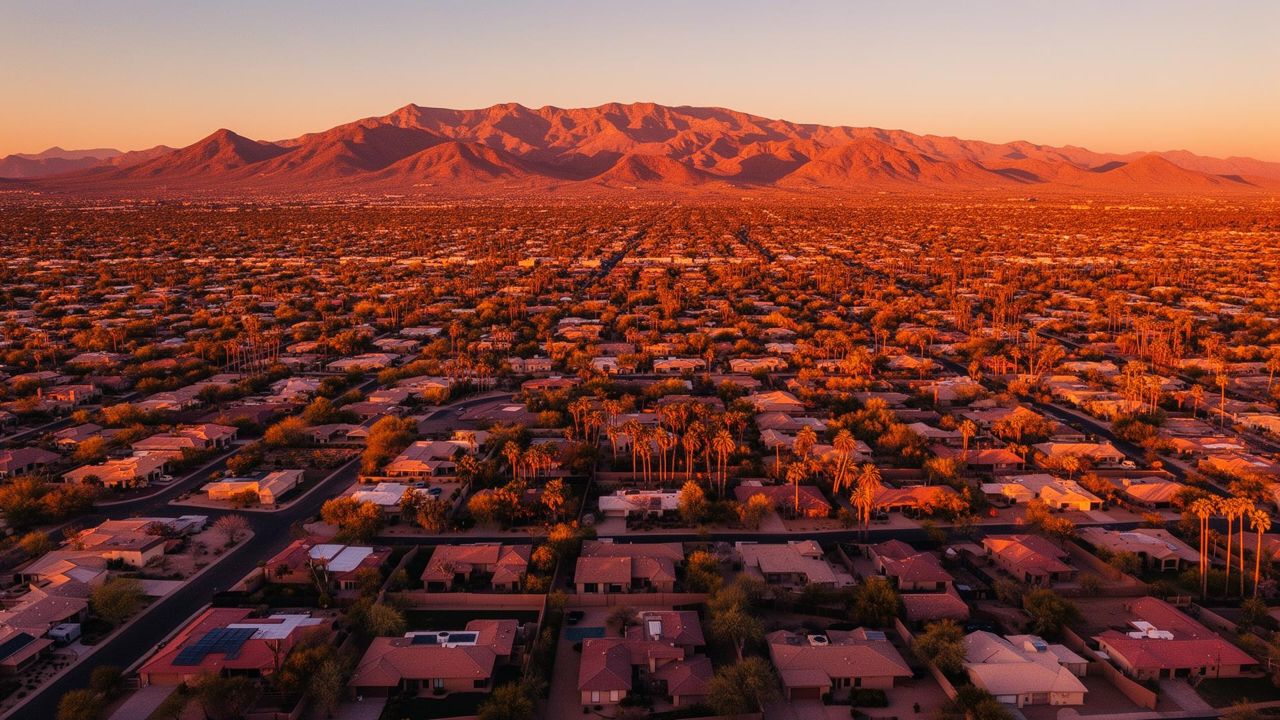
Center Street divides East Mesa from West Mesa, so the same street name can show up on both sides of town. For garage door repair in Mesa, the prefix on your address is the quickest hint at what you own. West of Center, the housing runs back to the 1910s and 1940s, and many garages were once carports. East of it, much of the housing was built from the 1990s onward, with heavy, insulated doors and bigger openers.
Mesa covers roughly 139 square miles and holds more than half a million people, which makes it the third-largest city in Arizona. If a door is stuck right now, call (480) 790-6364 and give the full address, including the East or West prefix.
Two Mesas, two repair profiles
Mesa was incorporated in 1883 with a few hundred residents and had about 63,000 people by 1970 and over 500,000 by the 2020 census. Nearly all of that growth arrived in waves: the original townsite, the postwar ranch neighborhoods, the lake communities of the 1970s and 1980s, the foothill golf communities of the late 1990s, and the master-planned build-out beside Phoenix-Mesa Gateway Airport that began in the 2010s. Each wave used different door hardware, different opening sizes and different assumptions about heat.
Older doors in west and central Mesa tend to fail because of age, wear and past patches. Newer doors in east Mesa tend to fail because of sun, weight and early settling. That is why one set of advice cannot cover the whole city.
West and central Mesa: ranch homes, carports and nonstandard openings
Fraser Fields, a central Mesa neighborhood near University Drive and Horne Drive, is described in the city's historic-district documentation as custom ranch homes from the late 1940s and 1950s, most with a single or double carport at one end and with garages that are either original or created by enclosing a carport. Evergreen, another historic district, reaches back further, with North Evergreen platted in 1910 and a mix of early bungalows and postwar ranches.
An enclosed carport rarely has a standard garage opening. The width may be a few inches off, the header may be shallow, and the ceiling may leave little room above the door for modern track and spring hardware. Sometimes the answer is a custom-cut door. Sometimes it is a much smaller fix, such as new rollers and a bottom seal on a door that still fits well. Measuring the opening before anyone quotes a price separates a door that closes square from one that never quite seals. That is what installation starts with in an older Mesa house.
Older doors also bring their own failure points. Many were built around extension springs that stretch along the horizontal tracks, rather than a torsion spring on a bar above the door. An extension spring without a safety cable can whip across the garage when it breaks, so replacing one is work for a professional. A very old opener may also predate the federal requirement for photo-eye reversing sensors, which took effect in 1993. If your opener has no sensors at the bottom of the tracks, replacing it is a safety decision as much as a repair.
Dobson Ranch and the lake communities
Dobson Ranch sits in southwest Mesa, between US 60, Loop 101, Guadalupe Road and Extension Road. The first homes were sold in the early 1970s and the community was built out in phases into the 1990s, with most houses dating from the 1970s and 1980s. Man-made lakes and a city-owned golf course run through it, and a homeowners association looks after the lakes and common areas.
A Dobson Ranch house from that era often means an attached two-car garage with one wide door and an opening that has already outlived at least one door. The door in place now is often the second or third generation. Typical faults at this age are worn rollers, hinges loose in their mounting holes, tracks drifting out of plumb and an opener that is a replacement of a replacement. Because the neighborhood has an association, check your governing documents before changing the color or panel style. A repair that keeps the door looking the same is a different matter from a new design.
East Mesa: Las Sendas, Red Mountain Ranch, Superstition Springs and Eastmark
Drive east and the housing stock changes character. Las Sendas sits near Usery Mountain Regional Park, and its gated Highlands neighborhood was built in the late 1990s. Red Mountain Ranch is organized around a country club. Superstition Springs is anchored by a mall that opened in 1990 and by its own golf club. An original door from the late 1990s is now more than a quarter century old, which is long enough for the first spring set to have been replaced and the first opener to be fading.
Eastmark is the other end of the spectrum. It occupies thousands of acres of the former GM Proving Grounds beside Phoenix-Mesa Gateway Airport, and the large majority of its single-family homes were built after 2000. Builders there offer a wide range of floor plans, so two neighbors can have different door styles, widths and hardware. Eastmark's governing documents and design guidelines apply to visible exterior changes, which makes a new door or color a request to submit, not a decision for a Saturday.
Newer homes in this part of Mesa rarely fail from old age. They fail from sun and size. A west-facing wall absorbs afternoon heat for hours, dark paint makes it worse, and a heavy insulated door puts more load on the springs and opener than a light single-layer door ever did. The newer the house, the likelier the first call is about balance, noise, a sensor knocked out of alignment or a door that sticks only in the afternoon. Check whether builder coverage still applies before paying for a repair.
Heat and rain in East Mesa
At the East Mesa climate station, the July mean daily high is about 106 degrees and the record is 121. A garage door absorbs that every day. Lubricant thins and dries out, rubber and vinyl weatherstripping hardens and cracks, steel expands against its tracks, and the logic board in an opener sits in a space that can run far hotter than the air outside. The practical result is a door that behaves in January and starts to bind or labor by August.
Mesa averages around 10.8 inches of rain a year, and outside winter, July and August are the wettest months. A monsoon storm brings gusts that load a closed door, blowing dust that works into tracks and rollers, and power cuts that stop the opener mid-travel. A door that will not move after a storm has usually lost power or collected dust on a sensor, but it can also have a bent track section from flying debris.
How the services line up in Mesa
Each service is available across the city, and how it plays out depends on the kind of house.
- Spring repair: older west Mesa doors may still run on extension springs, which should be replaced in matched pairs with safety cables. Newer east Mesa doors almost always use torsion springs sized to the door's weight, so a heavy insulated door needs a different spring than a light one.
- Opener repair: aging openers usually fail at the logic board, the drive gear or the travel limits. Newer Eastmark-era openers add Wi-Fi and battery backup, and those features can fail separately from the motor.
- Cable repair: cables fray where they wrap the drum and at the bottom brackets. A door that hangs lower on one side is the classic sign.
- Off-track repair: a roller that jumps usually follows a bump or a bent section, and in converted carports a door can also rack when the opening is slightly out of square.
- Panel replacement: older Mesa doors may use designs that are no longer made, and associations such as Eastmark's may want a match.
- Tune-up: a balance check, fresh lubrication and a sensor test before June are cheap insurance on a door of any age.
What a Mesa call involves
Give the full street address, including the prefix, what the door is doing and whether it is open, closed or stuck in between. The technician looks over the springs, cables, rollers, tracks, hinges and opener before touching anything, and measures the opening if a new door is possible. You hear what is wrong and what it costs before work begins, with a repair option and a replacement option when both make sense. Before the technician leaves, the door should be rebalanced and the reversing function and sensors checked.
Cost follows a handful of variables rather than a flat rate. Door weight decides the spring size. An opening that is not a standard size can mean a custom door. Worn drums or cables add parts. Panel availability decides whether a section can be replaced or the whole door has to go. For typical metro-wide ranges, see the repair cost guide.
Mesa borders several other cities. Gilbert lies to the southeast, where homeowners associations shape most repair decisions. Tempe is the next city west, with the rest collected on the service areas hub.