
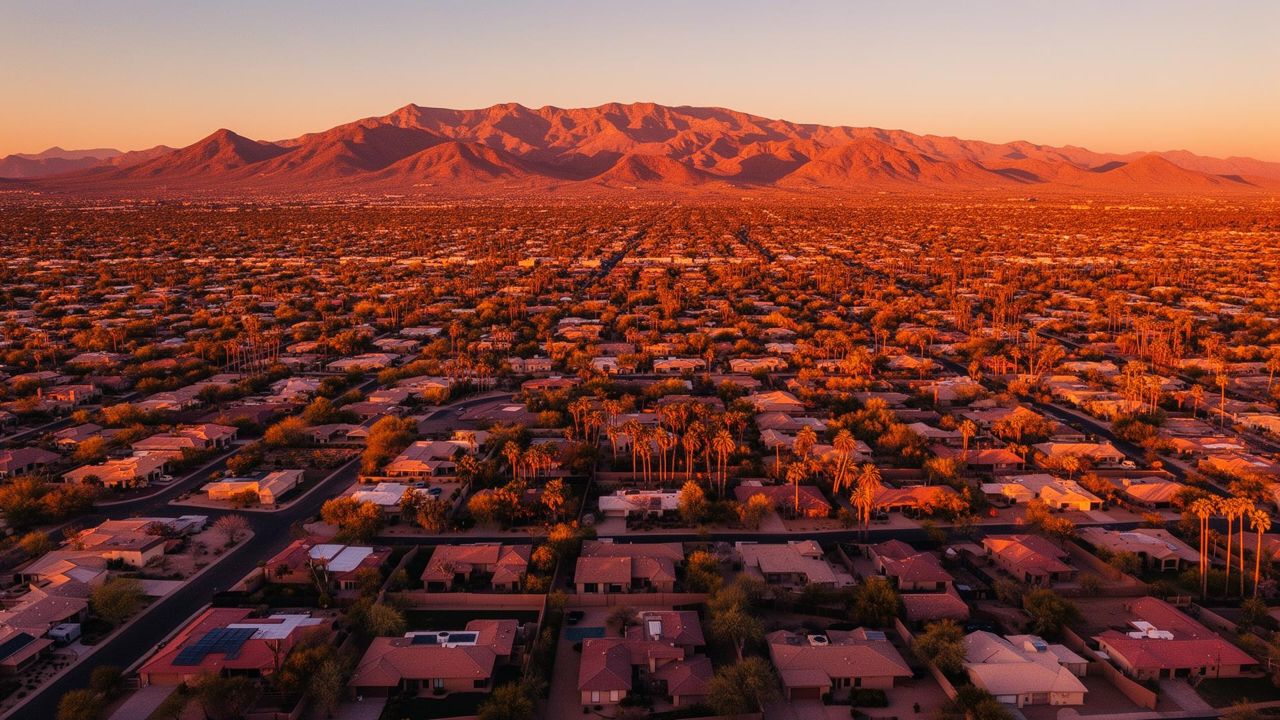
In Scottsdale, the first question about a broken garage door is often who has to approve the fix. Between the master-planned communities, the historic townhome districts and the custom homes of the north, a good share of the city's garage doors sit behind a design standard of some kind. This page treats garage door repair in Scottsdale from that angle: what you can fix freely, what usually needs sign-off, and how wood, carriage-style and custom doors hold up in desert sun.
If the door is broken and you need it working tonight, call (480) 790-6364. A failed spring or cable is a repair, not a design change, and it can usually be fixed while any approval for something cosmetic runs its course.
Repair versus change: where approval comes in
Most associations and design review committees care about what the street sees: color, style, window pattern and material. Arizona association guidance commonly lists garage doors alongside exterior paint, stucco and entry doors among the items that need an architectural request before work begins. Review usually turns on harmony with the community's design and colors. Replacing a broken spring, cable or roller does not change what the street sees, and neither does a new opener. A section in a different color, a new door style or added windows does.
That sets the order of operations. Fix what is broken first, so the door is safe and the garage is secure. If you also want a different door, submit the request in writing with the manufacturer's specification, a color sample and a photo of the house, and wait for the answer before ordering. When you are unsure, submit the request rather than guess, because it costs far less than replacing a door you were told to remove.
McCormick Ranch and Gainey Ranch
McCormick Ranch was Scottsdale's first upscale master-planned community. The working ranch was sold to a developer in 1970, and lakes, golf and miles of trails now run through a community of roughly 27,000 residents. Its association has an architectural control function, and that is the place to start for any exterior change. Homes there date from the 1970s forward, so original doors are mostly gone, and what you usually find is the replacement from the last remodel.
Nearby Gainey Ranch is a gated, resort-style community in central Scottsdale with its own golf club. If your community has a gate, send the code or guest instructions ahead of any visit so nothing delays the work.
DC Ranch and its many neighborhoods
DC Ranch sits against the McDowell Mountains in north Scottsdale on land that was a working cattle ranch for most of the twentieth century. Its first modern home was finished in the late 1990s, and the community is organized into dozens of neighborhoods grouped into four villages. The association keeps native landscaping and earth-toned architecture consistent from street to street, and with that many neighborhoods it helps to confirm which rules apply to yours before ordering a door.
Most homes there were built in the 2000s and 2010s, so doors are comparatively young. Repairs tend to involve openers, sensors, seals and individual panels, not worn-out original hardware, and the approval question usually matters more than the mechanics.
Villa Monterey and the historic townhomes
Villa Monterey, northeast of Old Town around Miller and Chaparral Roads, was built in sections between 1961 and 1973 and is often described as Arizona's first successful townhome project. Units 1 through 7 form a historic district on Scottsdale's register, and each section has its own association, so an exterior change can face more than one layer of review. The homes are attached, mostly single-story and built of masonry, with Spanish Colonial and period-revival facades. The practical path for owners there is repair in place. When replacement cannot be avoided, the door should respect the original look and clear the association and any historic review first.
Matching panels, faded finishes and discontinued models
Garage door repair in Scottsdale often comes down to a matching problem. A single damaged section can be replaced without replacing the whole door, but only when a matching panel exists. Doors tend to be a specific model in a specific color and texture, and after years of sun the existing sections have faded. A new panel in the same nominal color can read as a stripe against its neighbors. Ask whether the model is still made, whether its color has been revised and whether the panel will be factory-finished or painted to match.
If the model is discontinued or the match is poor, replacing every section or the entire door is usually the cleaner result, and a design committee will probably prefer it. Panel replacement suits the first case, where the door is otherwise sound and a match exists. Installation suits the second.
Wood, carriage-style and custom doors in desert sun
Custom homes often come with wood or wood-look doors in carriage-house styles, and desert conditions are hard on them. Real wood in the Valley needs to be sealed, stained or painted every few years, and a neglected wood door can warp, crack and lose color faster than steel or composite. Wood commonly lasts about 15 to 25 years in Arizona against roughly 20 to 30 for steel, aluminum or composite. Scottsdale's record high is 122 degrees, and a south- or west-facing wood door takes that sun for months at a time.
Weight is the part owners overlook. A solid wood door can be far heavier than a steel door of the same size, and every pound has to be balanced by the springs. When a wood door is refinished, a glass insert is added or a heavier overlay goes on, the balance changes, and springs that were right last year may be wrong now. A door that feels heavy by hand, or one that makes the opener labor, is telling you the springs need to be re-matched. That is a job for spring repair, not a bigger motor.
Many owners who want the look without the upkeep move to steel or composite doors with a wood-grain finish and carriage-style detailing, which hold their color through 115-degree summers with far less maintenance. Ask your association whether it requires real wood or accepts a wood-look door, then weigh the refinishing schedule against your appetite for upkeep.
South Scottsdale and Old Town: the mid-century core
Scottsdale starts with Army chaplain Winfield Scott, who bought 640 acres in 1888 where Old Town now sits. The town adopted a Western design theme for downtown in the late 1940s, incorporated in 1951, and grew more than sixfold during the 1960s. South of downtown that era is still visible. Town and Country, near 74th Street and Oak Street, was built in the late 1950s to designs by architect Ralph Haver, with low-pitched gable roofs and tall walls of glass, and it is a Scottsdale historic district.
Owners in districts like this often care about preserving the original look, and a heavy raised-panel replacement can sit awkwardly against a clean mid-century line. A garage door that is sixty years old is rarely the original, so the job is usually to keep a later installation working: balance, cables, rollers, sensors and an opener swapped once or twice. A yearly tune-up suits these houses, because the work is small, regular and invisible from the street.
North Scottsdale: custom homes and the desert edge
The north of the city is a different world from Old Town. Troon North and the Pinnacle Peak area sit in high Sonoran Desert among boulder outcrops, and the McDowell Sonoran Preserve, which voters funded with a dedicated sales tax in the 1990s, keeps large stretches of desert open nearby. Gated communities of custom luxury homes sit on large lots.
Doors on custom homes are specified one at a time. They are often taller, wider or both, with multiple bays, side-entry garages or glass sections, and many are made to order, so parts and matching panels can carry long lead times. A wider door needs heavier springs and, at some widths, extra support for the torsion shaft so it does not flex. An oversized door should be re-balanced after any repair.
Homes on the desert edge, with preserve land behind them, take wind and dust with nothing in between. After a haboob or a monsoon gust, check the photo-eye sensors before assuming anything is broken. A film of fine dust on a lens, or a sensor bumped out of line, will make a door refuse to close even when the opener is fine. When a made-to-order door fails after hours, emergency repair is the page to read, since replacement parts may take time to arrive.
Next to Scottsdale
Scottsdale's neighbors run from the dense grids of the central Valley to open desert. See Phoenix, Mesa and Tempe for conditions on their side of the line, and the service areas page for every community. When you call, say which part of Scottsdale you are in and whether there is a gate, and keep a picture of the door and its edge label handy, plus the association's approval letter if a style or color is changing.