
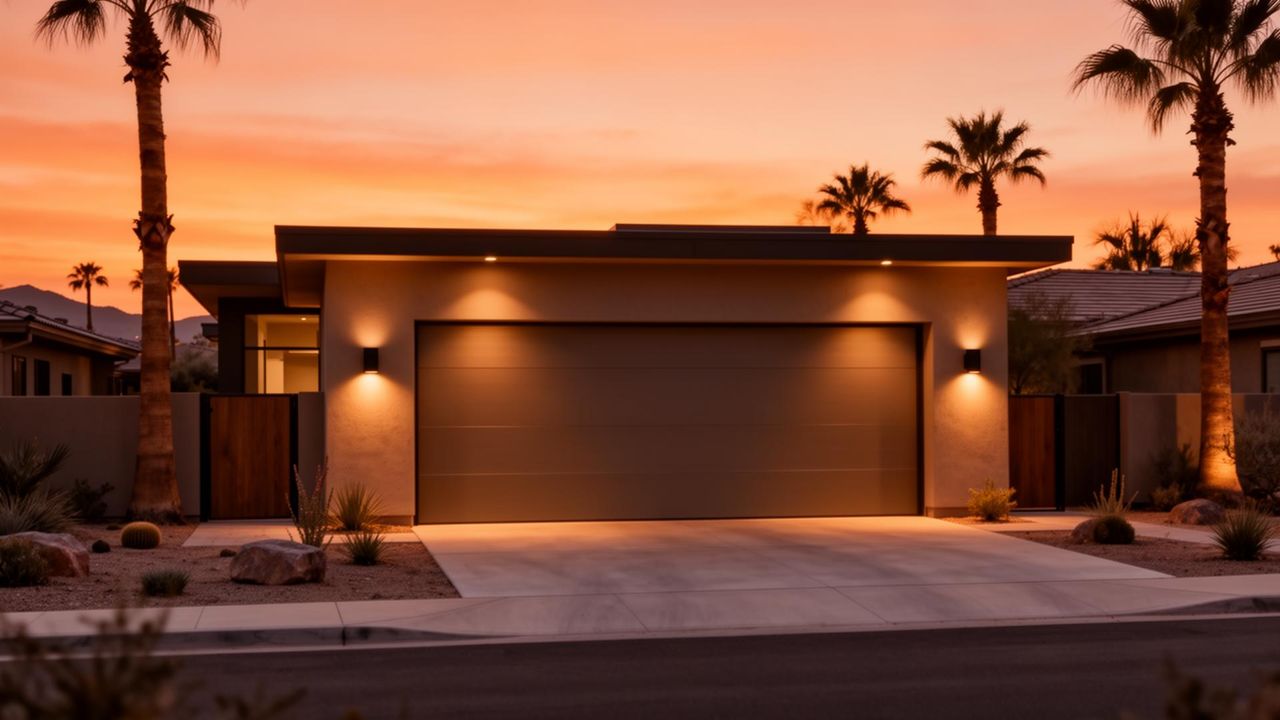
Choosing a garage door in Phoenix is mostly an exercise in managing heat. The door is the largest moving part of the house, it faces the street and often the western sun, and it closes off a space that can run far hotter than the air outside. Style matters, but what sits between the front skin and the back one matters more. This page covers garage door installation in Phoenix in the order the decisions come up: how to choose a door for this climate, how to size the opening, which approvals apply, how to pair an opener, what install day involves and what drives the cost.
If your current door has failed and the garage is exposed, read the emergency repair page first and call (480) 790-6364 to schedule a visit. A new door has to be measured and ordered, so expect a visit to the opening before any date is set.
Start with construction: single-layer, insulated and sandwich doors
Most residential steel doors fall into three constructions. A single-layer door is one sheet of steel with no insulation. It is the lightest and cheapest, and it is the most susceptible to dents. A two-layer door adds a polystyrene panel behind a steel front, held in place by a thin vinyl backing. A three-layer or sandwich door puts the insulation between two skins, and it is generally the most durable build.
Insulation type matters as much as thickness. Polystyrene is a board fitted behind the skin. Polyurethane is a liquid foam that expands to fill the cavity and bonds to both skins, which stiffens the section and helps it resist dents. R-value rates how well a section resists heat flow, and published numbers vary widely by product line. The number rates the section, not the whole opening. Gaps, worn seals and glass change what you actually get. The insulated garage doors in Phoenix guide goes through the options in detail.
In Phoenix the logic of an attached garage runs opposite to the usual northern story. In a cold climate an attached garage is a source of heat loss. Here the same wall is a source of heat gain, and any room above or beside a garage that bakes all afternoon feels it. An insulated, tightly sealed door will not turn the garage into a living space, but it narrows the temperature swing that the opener, the lubricants and the weatherstripping all have to endure.
Colors and materials that handle desert sun
Steel with a baked-on enamel finish is the usual answer to Valley sun, but ultraviolet light still fades and chalks paint over time, and fading can show within a year or two on a hard-exposure wall. A lighter color reflects more heat than a dark one, which is gentler on seals and lubricant, and it also hides fading better. Your association's palette comes first, then the choice within it.
Real wood is the most demanding material in this climate (UV grays and cracks it, heat warps it, coatings need renewing every two to three years), so many owners choose steel or composite with a wood-grain finish; ask the association whether that is accepted. Full-view glass and aluminum doors suit modern architecture, but glass lets sun into a garage that already runs hot. Double-pane glazing raises a window's R-value and low-E coatings reflect heat, so ask which glazing is offered and where the glass sits relative to the afternoon sun.
Wind load and monsoon gusts
Few openings in a house are as large as the garage door, and in a storm it is often the weakest point in the envelope. A Department of Energy building guide explains why: if the door fails, wind can pressurize the building and push out windows, walls and roof. It lists three typical failures, which are panels that buckle inward, doors pulled outward out of their tracks, and breakdowns in the hardware that holds the door in place. Valley gusts are real, and newer subdivisions at the desert's edge have nothing to slow the wind before it reaches the door.
What to ask for is a door tested to ANSI/DASMA 108 or ASTM E330, with the positive and negative test pressures recorded, and not just the words wind-rated. The International Residential Code's garage door provision points to those standards. Whether the requirement applies at your address depends on the local code, so confirm with your building department. Exposed sites call for higher design pressures than sites surrounded by buildings or trees, and wide doors benefit from reinforcement struts. Glazing deserves a question of its own.
Sizing the opening
Measure before choosing, because the expensive mistake is ordering a standard door that almost fits. Width goes between the inside jambs. Height is taken at the left, center and right, because slabs slope. Headroom decides the spring setup: standard torsion hardware commonly needs about 12 to 15 inches above the opening, extension hardware about 10, and low-headroom track exists for less. Back room should be at least the door's height plus 18 inches. A double-width door spans about sixteen feet, and a long span flexes unless it is reinforced and carefully balanced. A three-car garage multiplies all of this, since each door has its own springs, cables and opener.
What each Valley housing era needs from a new door
1950s to 1970s ranch homes. Many of these garages were built for one car, or began as a carport that was enclosed later, so openings can be narrow, out of square or short on headroom. Original doors were often one-piece tilt-up slabs that swung up and over, and most have been replaced by now. A side-mounted opener can solve a ceiling that will not take a standard rail. In Phoenix's designated historic districts, check with the city's historic preservation office before changing how the door looks from the street.
1990s to 2010s master-planned communities. The association owns the look. Colors come from an approved palette, the panel design and window pattern may be fixed by the street's style, and a builder-grade door installed in 2005 is often at the thin-steel end with a 10,000-cycle spring. A replacement is a chance to correct that, inside the approved design. Pull the association's guidelines first, then choose within them.
HOA approval and permits: association first, then the city
Arizona community-manager guidance puts garage doors on the list of exterior changes that need an architectural request, and committees check design, color and materials against the community's standards. Submit a complete package: the manufacturer's specification, a color sample and a photo of the house. Wait for the answer in writing before ordering. A door ordered ahead of approval is a door that may have to go back.
The city side depends on where you live. As a general pattern, swapping a door in the same size opening is treated differently from changing the opening itself. Widening an opening, raising a header or altering the structure is the point at which to ask your city's building department first. Historic districts add their own review.
Pairing the opener with the door
The springs lift the door and the opener only guides it. A new opener cannot fix a door that is out of balance, and industry guidance says not to raise the force setting to cover for a door that does not move freely. Choose the door and springs first, then the opener.
- Chain drive: strong and simple, and usually the loudest.
- Belt drive: quieter, which suits a garage that shares a wall with a bedroom.
- Wall-mounted jackshaft: sits beside the torsion bar and frees the ceiling, which helps when headroom is tight or the ceiling is high.
- Battery backup: keeps the door moving through an outage, and it deserves a yearly trial run.
Federal rules require openers built from 1993 onward to carry entrapment protection, almost always photo eyes or an edge sensor. An older unit without them is a safety reason to replace the opener on its own. If your existing opener is fairly young, quiet, has photo eyes and still pairs with modern remotes, it can often stay. The opener repair page covers brands, drive types and when replacement makes sense.
Springs, install day and cost
Plan on most of a day for a standard single door. The old door and its springs come out under control, the opening is checked for rot or header damage, then the new tracks, springs, cables and sections go in, the door is balanced by hand, and the opener is set, aligned and tested for reversal. Choose a higher-cycle spring on day one (25,000 cycles instead of 10,000), since it is the cheapest durability upgrade; the spring repair page has the cycle math. Price depends on construction and gauge, size and count, windows, material, finish, wind rating, opener and any opening repair, and no number is honest until someone has measured. You hear an itemized price before work starts. See the repair cost guide for market ranges, and consider panel replacement first if only one or two sections are damaged on a sound door.